














A good small gig does not have to begin with recognising the name at the top of the poster. It can begin with a venue you can get home from, a promoter whose choices interest you and one track that makes you curious.
To find small gigs you will actually attend, narrow the search before opening a ticket site. Choose a realistic travel area, a total budget and a couple of evenings you can make. Then look for music within those limits. You are more likely to book something than if you scroll through every concert in the country.
Start with venues, then follow the promoters
Music Venue Trust, the charity supporting grassroots music venues, offers a venue map and gig guide. Use these as a starting point, then check the venue’s own calendar for the current event details and official ticket link.
Pick two or three places within a journey you would happily make on a weeknight. You might find a dedicated music room, a pub with a live programme or an arts space running occasional shows. Read each listing closely: a seated performance, a standing gig and a club night can be very different evenings in the same building.
Notice who is promoting the shows that interest you. A promoter may put on similar music in several venues, so its calendar or mailing list can be more useful than repeatedly searching one building’s name. An artist you enjoy can also lead you towards support acts and other musicians on the same bill.
Give an unfamiliar line-up ten minutes
Play one current track by the headliner and one by a support act through an official artist page or authorised service. If there is an official live session, use it to explore the performance format. A solo electronic set and a full band may call for different expectations even when the recordings share a genre label.
You are deciding whether the evening interests you, not whether the artist deserves a permanent place in your favourites. Save the listing if you hear enough to be curious, then return to the practical details before paying.
If you liked our feature on Ren and The Big Push, following the musicians behind a performance is another way to start exploring. Check their current official pages for future shows rather than treating an older feature as a live events listing.
Budget for the whole evening
Check the checkout total, including booking charges, and add transport, any cloakroom cost and what you expect to spend inside. A low ticket price can be outweighed by an expensive late journey home.
For illustration, a £15 ticket, £2 booking fee, £6 return bus fare and £5 drink would make a £28 evening. These are example figures, not prices for a particular venue. Replace them with the costs of your own plan and leave room for a change of transport.
Follow ticket links from the venue, artist or promoter. If a show has sold out, check the organiser’s stated resale arrangements. Do not assume that a stranger’s screenshot or a social-media reply is a valid ticket.
Confirm the venue and room, age limit and ID rules, total price, access arrangements and your route home. Then check doors, expected stage times and finish time separately.
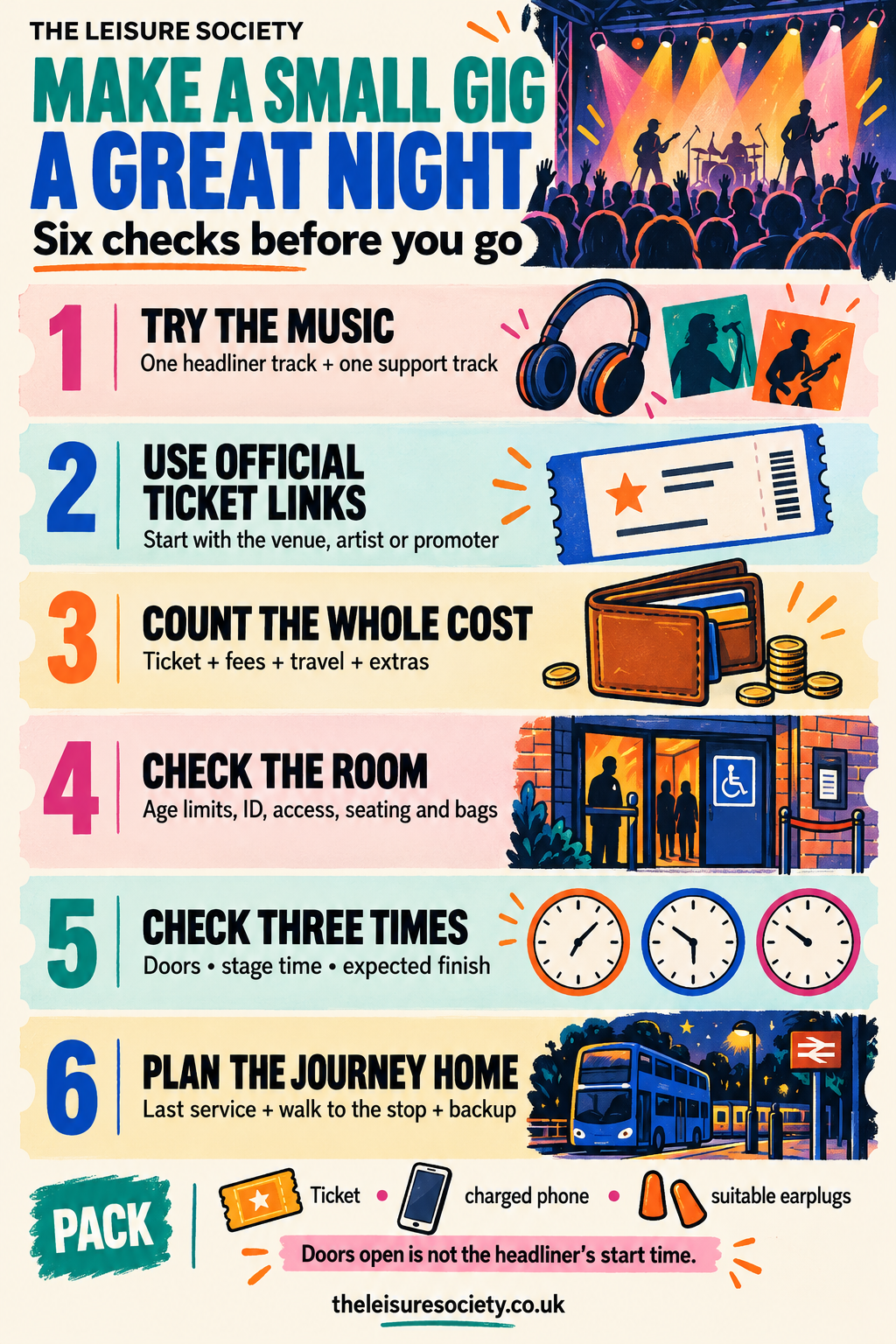
Doors open is not the headliner’s start time
A listing’s doors time tells you when entry begins. It does not necessarily tell you when the first act starts, when the headliner appears or when you will leave. A published curfew is also not a guarantee that the music will run right up to it.
For example, Brighton’s Green Door Store explains in its FAQ that set times are decided by the promoter and can change. The same page states its own 18-plus entry and ID requirements. Those are venue-specific details, which is precisely why it is worth reading the actual listing and venue information rather than relying on a general assumption.
If your last train is the deciding factor, ask about expected timings before booking. Check the timetable for the correct date, including the journey from the venue to the stop or station. Decide whether you would still want the ticket if you had to leave before the end.
Check access for the particular show
Small does not automatically mean accessible, seated or easy to navigate. Look for information about the entrance, steps, toilets, viewing position and the route between them. If you need a seat, a companion ticket or a particular arrangement, contact the venue before purchasing rather than assuming these can be sorted on arrival.
Attitude is Everything’s resources are a useful reference for live music access. The venue’s own access information remains essential: layouts and booking procedures differ. Green Door Store, for instance, publishes specific viewing-area arrangements and advance-notice requirements.
Tell the venue what you need in practical terms and keep its reply with your booking. If the answer is unclear, ask for clarification while you still have other options.
Make the night comfortable, including if you go alone
Check bag restrictions and cloakroom availability, charge your phone and have your ticket accessible before reaching the entrance. If you are going alone, arriving for the support gives you time to find the room and settle in without waiting for someone else’s schedule.
Bring suitable hearing protection. RNID’s advice for music fans includes using earplugs, taking breaks somewhere quieter and keeping away from speakers. Earplugs are one part of protecting your hearing, not a reason to ignore excessive volume.
After the show, save the names of the artists and promoter you would see again. A short personal list of good nights, reliable venues and manageable journeys is more useful than another enormous list of events you never get around to booking.