
















Two nights in Ghent give you an evening beside the old quays, a full day for its castle and the Ghent Altarpiece, and a final morning that need not become a race for the train. The historic centre is compact enough to explore on foot once you arrive, though the main railway station is outside it.
From London, the route is Eurostar to Brussels-Midi/Zuid, then an SNCB train to Gent-Sint-Pieters. It suits travellers who can reach St Pancras comfortably and want a city break built around art, architecture and meals rather than a packed sightseeing list. This itinerary keeps all three days in Ghent.
Things to do at a glance
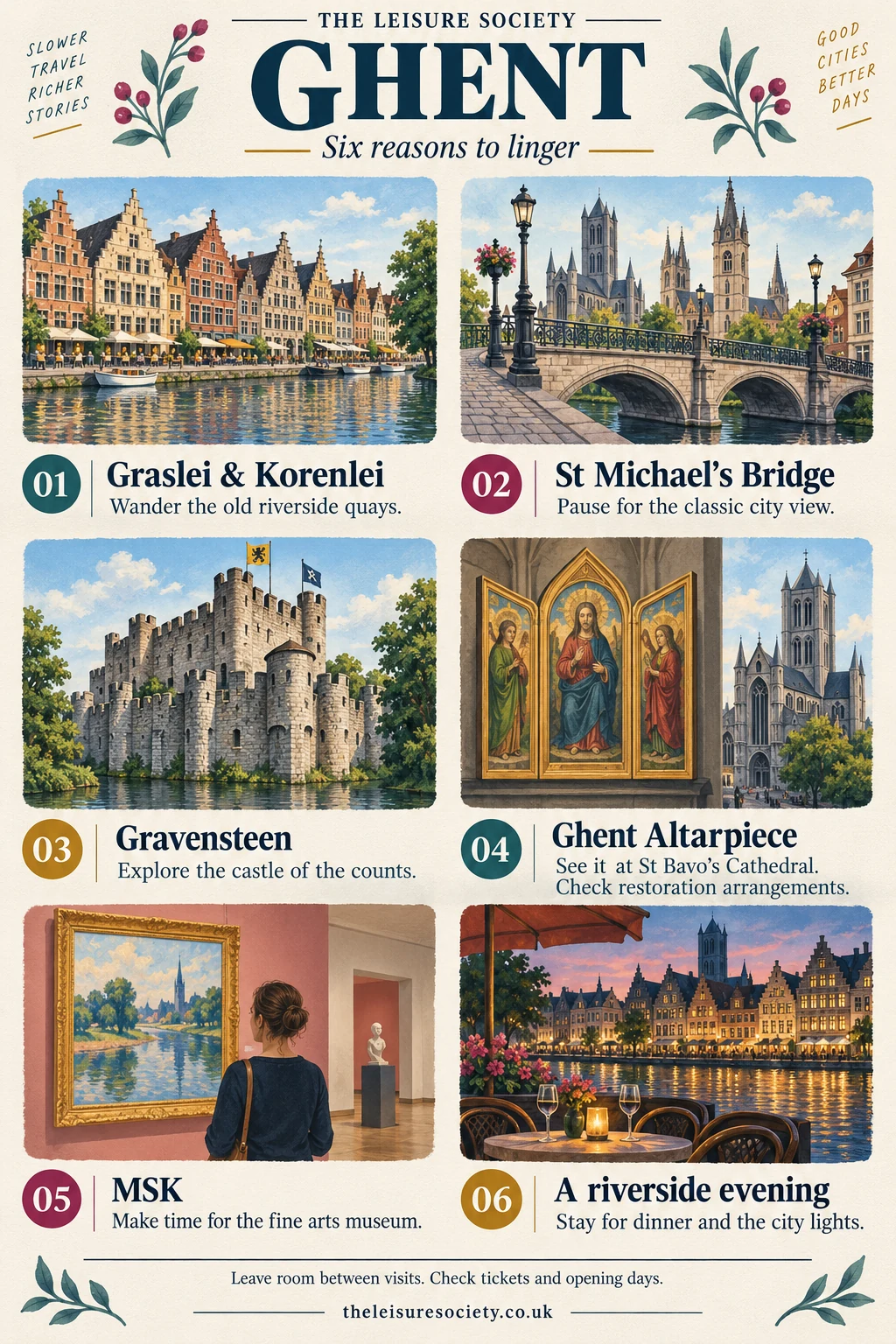
Read the infographic: six things to do
- Graslei and Korenlei: wander the historic riverside quays.
- St Michael’s Bridge: pause for the city view.
- Gravensteen: explore the castle of the counts.
- Ghent Altarpiece: visit St Bavo’s Cathedral and check restoration arrangements.
- MSK: make time for the Museum of Fine Arts.
- A riverside evening: stay for dinner and the city lights.
How to reach Ghent by train from the UK
Eurostar’s London–Ghent route guide advertises a journey of around two hours and 50 minutes, including the change in Brussels. That is a rail journey time, not the time from arriving at St Pancras to reaching your hotel. Compare the full itinerary for your departure, including any UK train connection.
Book to Gent-Sint-Pieters, the name used for Ghent’s main station. In Brussels, Midi and Zuid are two names for the same station, so there is no cross-city transfer. Follow the departure boards for your onward SNCB train. Eurostar sells the combined journey and says its SNCB ticket can be used on any train on the booked route that day. The Eurostar service itself is reserved. Older advice about buying an “Any Belgian Station” supplement is out of date, as that product has been withdrawn.
The Belgian leg is relatively short. SNCB lists an average Brussels–Ghent journey of 36 minutes, although your exact departure station and service matter. Check Gent-Sint-Pieters on the stopping pattern rather than relying on the train’s final destination.
For Standard and Plus passengers, Eurostar’s current arrival guidance recommends reaching St Pancras 75 minutes before departure and Brussels-Midi/Zuid 45–60 minutes before the return service. Gates close 30 minutes before departure at both. Follow the arrival time on your ticket if it differs, and leave additional room for a delayed UK or Belgian connection. The gate-closing time is not a sensible arrival target.
Getting from Gent-Sint-Pieters to the centre
Gent-Sint-Pieters station serves the Arts Quarter as well as the city centre. With luggage, a tram is a practical starting point for a hotel around Korenmarkt or the river. Use your accommodation’s exact address when planning the final leg.
At the October 2026 check, De Lijn’s current tram network showed T1 from Sint-Pietersstation via the Kouter area towards Zuid, with some services continuing to Stelplaats Gentbrugge. Use the operator’s journey planner to choose the stop nearest your hotel. T3 is suspended until May 2027, so do not rely on older visitor advice that recommends it. Check the route again on arrival.
A De Lijn single ticket costs €3. You can pay contactlessly at the white terminal on the vehicle, or buy through the app and activate the ticket before boarding. Transfers are permitted within 60 minutes. A contactless ticket also lets you finish the ride after that period. CityCard Gent includes eligible local tram and bus journeys, but not your Brussels–Ghent train.
Where to stay for a two-night visit
For a first visit, look around Korenmarkt, Graslei and Korenlei if walking back after dinner matters most. A hotel near Gent-Sint-Pieters makes an early departure easier and puts the MSK museum within reach, but adds a journey to and from the old centre. Compare the total room price for both nights, including any taxes and breakfast, rather than assuming either area is always cheaper.
Before reserving, check luggage storage for your arrival and departure days, lift access and recent comments about street noise. In a historic building, “central” does not mean step-free. If you need an accessible room, ask about the entrance, bathroom and lift dimensions directly.
Day one: the quays, bridges and an unhurried dinner
Drop your bags before starting at Korenmarkt. Walk to St Michael’s Bridge for the riverside view, then explore the facing quays of Graslei and Korenlei. The old port buildings help explain why the water is central to Ghent’s story. Continue towards Grasbrug and the castle exterior, leaving its paid visit for the next day.
Allow an afternoon for this walk with stops, rather than booking a timed attraction immediately after your train. It gives you a flexible first day if the journey runs late. Return towards the river after dinner to see the waterfront in evening light.
For something specifically local, look for waterzooi, a creamy dish made with chicken or fish, vegetables and potatoes. Patershol, near the castle, is another area to consider for dinner. Check the actual menu and reserve a table for a weekend evening. A restaurant recommendation should fit your tastes and budget, not simply have a view.
Day two: Gravensteen and the Ghent Altarpiece
Make the Castle of the Counts, or Gravensteen, your morning visit. Its keep and defensive walls tell a different story from the merchant buildings by the river. Adult admission is €15. Reserve ahead if paying individually, while CityCard holders do not need a timed reservation. Allow roughly 90 minutes as a planning allowance, with more time if you want to linger over the audio tour.
The displays include punishment and torture equipment, which may not suit younger children. Access is another important limitation: the castle’s own accessibility information says it is not wheelchair accessible and describes more than 480 steps, including narrow spiral staircases. For a visit without that climb, concentrate on the cathedral visitor centre, which has ramp and lift access.

Leave lunch and walking time before an afternoon appointment with the Ghent Altarpiece at St Bavo’s Cathedral. Completed in 1432 by the Van Eyck brothers, it is a reason to give Ghent a full day rather than a quick stop between cities.

The cathedral lists an Altarpiece-only visit at €12.50, lasting about 25 minutes, or a standard augmented-reality visit at €16, lasting about an hour. Pick the experience before booking. CityCard holders receive a €10 discount but still need to reserve online and show both the booking and their card.
The visitor centre opens Monday to Saturday from 10am to 5pm and Sunday from 1pm to 5pm. The last entry for the standard hour-long visit is 4pm. A Sunday morning departure therefore cannot accommodate it. The cathedral’s access guide explains the ramp, lifts and adapted toilet.
Is CityCard Gent worth buying?
CityCard Gent costs €49 for 48 hours or €55 for 72 hours. It covers listed attractions, local public transport and one guided boat trip, among other benefits. The €10 Altarpiece discount leaves €6 to pay for the standard €16 visit.
For one adult paying full admission, this is the comparison for the core itinerary. It assumes two €3 tram journeys and all visits within the pass’s validity.
| Item | Separate tickets | With 48-hour CityCard |
|---|---|---|
| CityCard | Not needed | €49 |
| Gravensteen | €15 | Included |
| Standard Altarpiece visit | €16 | €6 supplement |
| Two tram journeys | €6 | Included |
| Total per adult | €37 | €55 |
On that plan, separate tickets save €18. Adding the MSK at its currently listed €19 general admission brings separate tickets to €56, against €55 with the pass. A saving of €1 is a slim reason to buy it, although an included boat trip or additional paid visits could make it better value.
These are sightseeing and local transport costs only. Add return rail fares, two nights’ accommodation and meals to calculate your trip budget. Children and young adults may qualify for cheaper individual admission, so calculate their costs separately. Buy the pass for visits you already want to make, and check its validity against your arrival and departure times.
Day three: choose a riverside morning or the MSK
For a relaxed departure, keep the morning for breakfast and a final walk near your hotel. Collect your bags before heading to Gent-Sint-Pieters, with enough margin to reach Brussels for Eurostar’s recommended arrival time.
If art is the priority and your train leaves later, the Museum of Fine Arts, or MSK, is a useful alternative. It opens at 10am on Saturdays and Sundays and is about 15 minutes’ walk from Gent-Sint-Pieters. It is closed on Mondays. During the restoration, a Sunday visit can show you the upper panels discussed above, alongside the museum’s collection, but not the conservators at work. Arrange luggage storage and leave time for the walk back to the station.
For wet weather on your full day, the MSK can replace the longer riverside walk. It should replace an activity rather than become another appointment squeezed between the castle and cathedral. Keeping one part of the day flexible is what makes this two-night itinerary manageable.
Before you book from the UK
For a typical short tourist visit on a full British citizen passport, the UK government’s Belgium entry guidance requires a passport issued less than ten years before arrival and valid for at least three months after your planned departure from the Schengen area. Visa-free visits are normally limited to 90 days in any 180 across the Schengen area, not separately for each country.
Check those requirements alongside your rail tickets, then reserve the Altarpiece visit and accommodation. With the train connection and one timed art visit settled, the rest of the weekend can stay simple: the quays on arrival, the castle and cathedral on the full day, and a final morning chosen around the journey home.
Further Reading