


















Three days in Porto is enough for the historic centre, a port cellar in Vila Nova de Gaia and a half-day at Serralves, without hiring a car. The trick is to group sights by area and elevation: a short line on the map can conceal a steep climb from the Douro waterfront.
This itinerary suits a first visit with three full sightseeing days. Start with Bolhão, São Bento and Ribeira, cross to Gaia on day two, then spend day three at Serralves. If your flights leave only two usable days, keep the first two routes. If one falls on a Sunday, move the Bolhão visit to another day.
Things to do at a glance
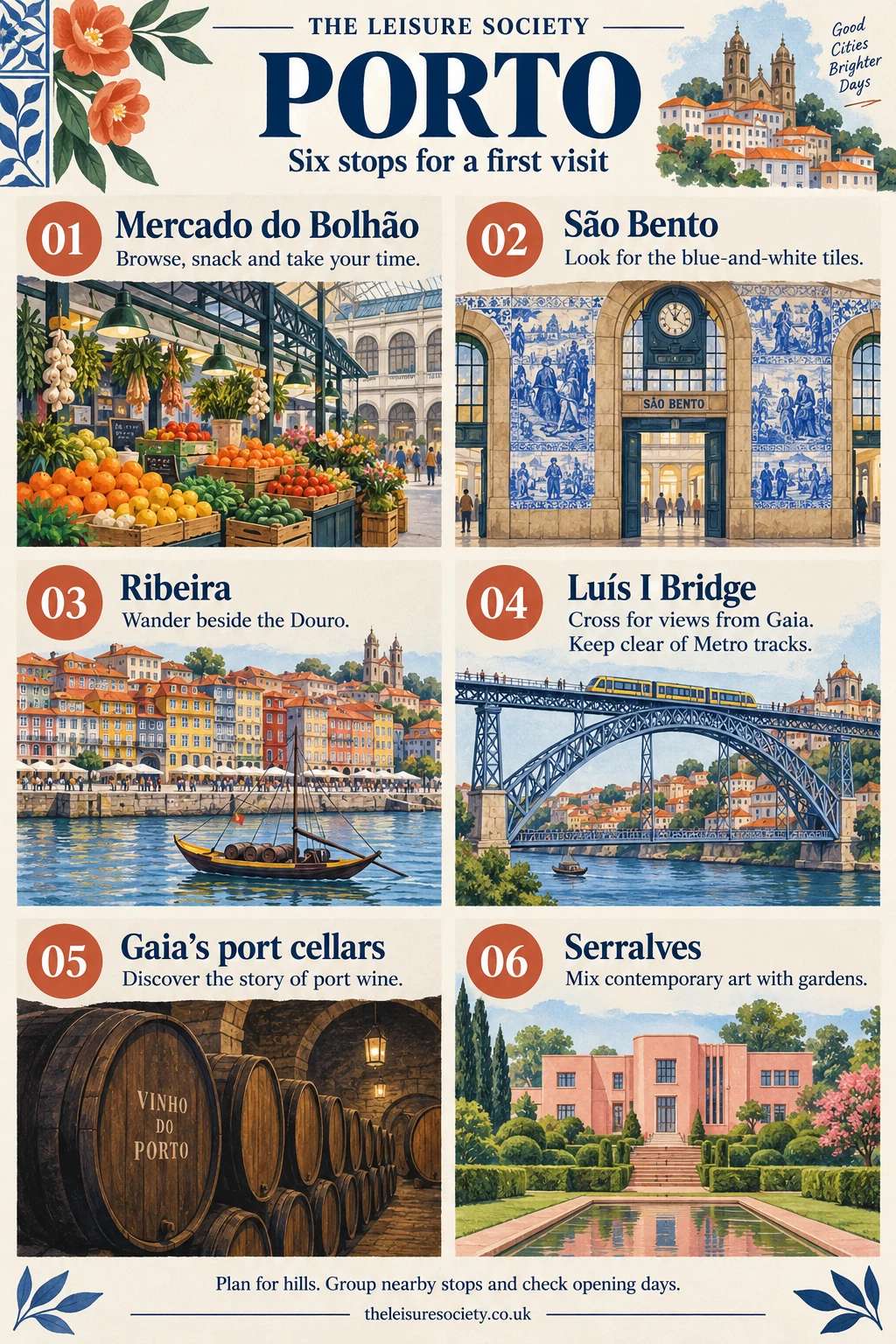
Read the infographic: six things to do
- Mercado do Bolhão: browse, snack and take your time.
- São Bento: look for the blue-and-white azulejo tiles.
- Ribeira: wander beside the Douro.
- Luís I Bridge: cross for Gaia views and keep clear of Metro tracks.
- Gaia’s port cellars: discover the story of port wine.
- Serralves: combine contemporary art with gardens.
Where to stay in Porto without a car
For a first visit, start your accommodation search around Trindade or Bolhão. Both make useful bases for combining public transport with the central sights. Ribeira is worth considering if being beside the Douro matters more to you, but expect uphill journeys when you leave the waterfront.
Check the route from the station to the actual hotel entrance, particularly if you have wheeled luggage. A short distance does not guarantee level pavements, and an attractive upper-floor room is less appealing if the building has no lift. Ask about steps, gradients and access rather than relying on a property’s general description. Porto’s official accessible travel resources are a starting point; travellers needing step-free access should confirm the complete route with their accommodation and attractions.
Getting from Porto Airport to the centre
Metro line E, the purple line, serves the airport. Visit Porto gives approximately 30 minutes to Trindade, before waiting time and the journey to your hotel. For early departures or late arrivals, check the current first and last services through the airport’s transport guide; have a taxi or transfer alternative if the timetable does not fit.
The airport-to-central-Porto journey needs a Z4 ticket. Under the 2026 Andante tariff, that costs €2.30, plus €0.60 for a reusable Andante Azul card if you do not already have one: €2.90 for the first journey. Each traveller needs their own card. Select the destination at the ticket machine to confirm the required zone, rather than assuming every subsequent journey is also Z4.
Validate your ticket before boarding the Metro and again when changing lines or transport. Keep the card for later trips. The Andante Azul guidance explains how its reusable tickets work.
If you expect frequent rides, Andante Tour costs €7.75 for 24 hours or €16.55 for 72 consecutive hours from first validation. It covers the Andante network, including the airport Metro, but excludes the Guindais funicular and STCP heritage trams. This is a transport ticket, not an attraction pass. Walkers may spend less on individual fares; check whether your return airport trip will fall inside the 72-hour window before buying.
Day one: Bolhão, São Bento and the Ribeira waterfront
Begin at Mercado do Bolhão and allow roughly an hour to browse and stop for something to eat. That is a suggested planning allowance, not a fixed visit length. The market’s published hours are 8am–8pm Monday to Friday and 8am–6pm Saturday; it is closed on Sunday. Restaurant hours can differ, and public holidays need a separate check.
Continue towards São Bento railway station to see the azulejo tile panels in the entrance hall, then head to the cathedral area. Leave room for this upper-town section through late morning rather than assigning a booking to every stop. São Bento is a working station: keep doorways and passenger routes clear. If you want to enter cathedral spaces, check the current admission arrangements rather than assuming every part is free.

From the cathedral area, descend towards Ribeira for the afternoon. Use Visit Porto’s historic district guide to orient yourself, then choose a route that suits your group. Cobbled slopes and steps make sturdy shoes useful; on a wet day, slow down and avoid treating the shortest route as the easiest.
Leave time for lunch and the riverfront instead of immediately crossing to Gaia. For a recognisably local dish, look for a francesinha: a substantial meat-filled sandwich covered with cheese and sauce, described in Visit Porto’s guide to traditional eating places. Check ingredients and portion sizes before ordering; vegetarian versions and dietary suitability depend on the restaurant.
Compare menus before settling on a riverside terrace, especially if the view is less important to you than the food. Plan the return to your hotel before dinner. Staying near Trindade or Bolhão means getting back uphill, so leave time and energy for that final leg or use transport.
Day two: cross to Gaia for views and a port cellar
Start on the cathedral side of the Luís I Bridge and cross its upper deck towards Jardim do Morro in Vila Nova de Gaia. The upper level carries Metro trains as well as pedestrians. Stay in the designated walking space and avoid stepping into the tracks for photographs.

Take in the view before deciding when to descend. The upper viewpoint, hillside cellars and lower waterfront are different levels, so grouping them carefully matters more than squeezing in another stop. If a cellar visit is your priority, check its entrance on the map first: descending to the river too early can mean climbing straight back up.
One option is Taylor’s at Rua do Choupelo 250. Its adult audio-tour ticket is €25, including three port wines, with an English-language guide available. Taylor’s visitor FAQ suggests around an hour for the tour and another 30 minutes for the tasting, although there is enough material to stay longer. Leave about two hours in your itinerary rather than putting lunch immediately after the minimum visit time.
The standard audio tour accepts walk-ins subject to availability, so advance booking is a choice rather than a requirement. Tickets for ages 8–17 cost €9 and include grape juice and biscuits; under-eights enter free. Adult non-drinkers should ask about suitable alternatives before paying. Private tours and larger groups have different booking arrangements.
Afterwards, spend the remaining afternoon along Gaia’s waterfront. You can return towards Ribeira via the bridge’s lower level, but still need to account for the climb if your hotel is in upper Porto. If you prefer to skip wine altogether, keep the bridge and waterfront walk, then use the spare time in the historic centre.
A Gaia cellar visit is not a vineyard excursion in the Douro Valley. For this three-day city itinerary, treat a valley trip as a replacement for a whole sightseeing day, not an extra to fit between lunch and dinner.
Day three: allow half a day for Serralves
Serralves brings together contemporary art, gardens and an Art Deco villa, offering a change from the old centre. Allow a half-day on site, plus travel, as a planning starting point. Art enthusiasts may want longer; visitors with little interest in exhibitions can choose the gardens or spend the day back in the centre.
Serralves’ visitor information lists bus 207, linking the Aliados area with the Serralves Museum stop. Check the current stop and direction before setting off. There is no Metro station at the entrance; travelling via Casa da Música still involves an onward bus journey.
For visitors who are not Portuguese residents, general admission is €24 and includes the museum, park, Treetop Walk, villa and House of Cinema. Park-only admission is €15. Resident discounts and the resident free-entry scheme should not be included in a UK visitor’s budget unless they qualify.
The published October–March hours are 10am–6pm on weekdays and 10am–7pm at weekends and on public holidays. Check seasonal hours, exhibition changes and temporary closures before visiting; particular buildings may be unavailable even when the wider estate is open.
In rain, concentrate on the indoor exhibitions and shorten the garden walk. If you keep this as your final day before flying home, work backwards from the airport journey and leave room to collect luggage. Do not assume a half-day visit will fit comfortably before an early-afternoon flight.
What to budget for transport and sightseeing
| Item | Cost |
|---|---|
| Andante Tour 3, valid for 72 hours | €16.55 |
| Taylor’s standard audio tour and tasting | €25 |
| Serralves general admission | €24 |
| Porto tourist tax for three nights | €9 |
| Total for these items | €74.55 |
Porto’s municipal tourist tax is €3 per person per night, charged for up to seven consecutive nights, with exemptions including children aged 12 and under. Ask your accommodation whether it is already included in the quoted total. Gaia is a separate municipality, so confirm the applicable charge if you stay there.
Add flights, accommodation, meals, drinks and any extra attractions to this example. It assumes all your transport journeys fall within the pass’s validity. Choosing individual fares, skipping the cellar tour or taking the park-only Serralves ticket changes the total. If considering a Porto.CARD, compare its current discounts and transport option with these actual plans before buying.
Before travelling from the UK
For travellers using a full British citizen passport, FCDO Portugal entry guidance says the passport must have been issued less than ten years before arrival and expire at least three months after the planned departure from the Schengen area. Short tourist visits are normally visa-free within the combined Schengen limit of 90 days in any 180-day period. Check the latest border procedures and your airline’s requirements before departure.
Keep the route flexible enough to move the outdoor walking to the better-weather day. Confirm Bolhão’s opening day, any attraction booking and the airport transfer first; then leave the spaces between them for a café stop, a longer lunch or somewhere you want to revisit.