

















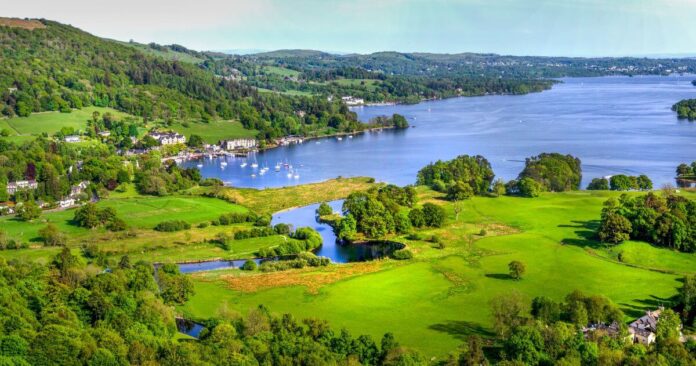
A Lake District break without a car is easiest when you stay around Windermere and use the lake as part of the journey. Arrive by train, walk up Orrest Head for your first view, then link Bowness, Ambleside and Grasmere by passenger boat and bus. There is enough here for three days without changing hotels or spending the holiday chasing connections.
This plan suits a first visit, with two nights in Windermere or Bowness, an arrival around lunchtime and a late-afternoon departure. It combines short walks with time in the towns rather than remote valleys or major fell climbs. If your journey from home takes most of a day, add a third night.
Things to do at a glance
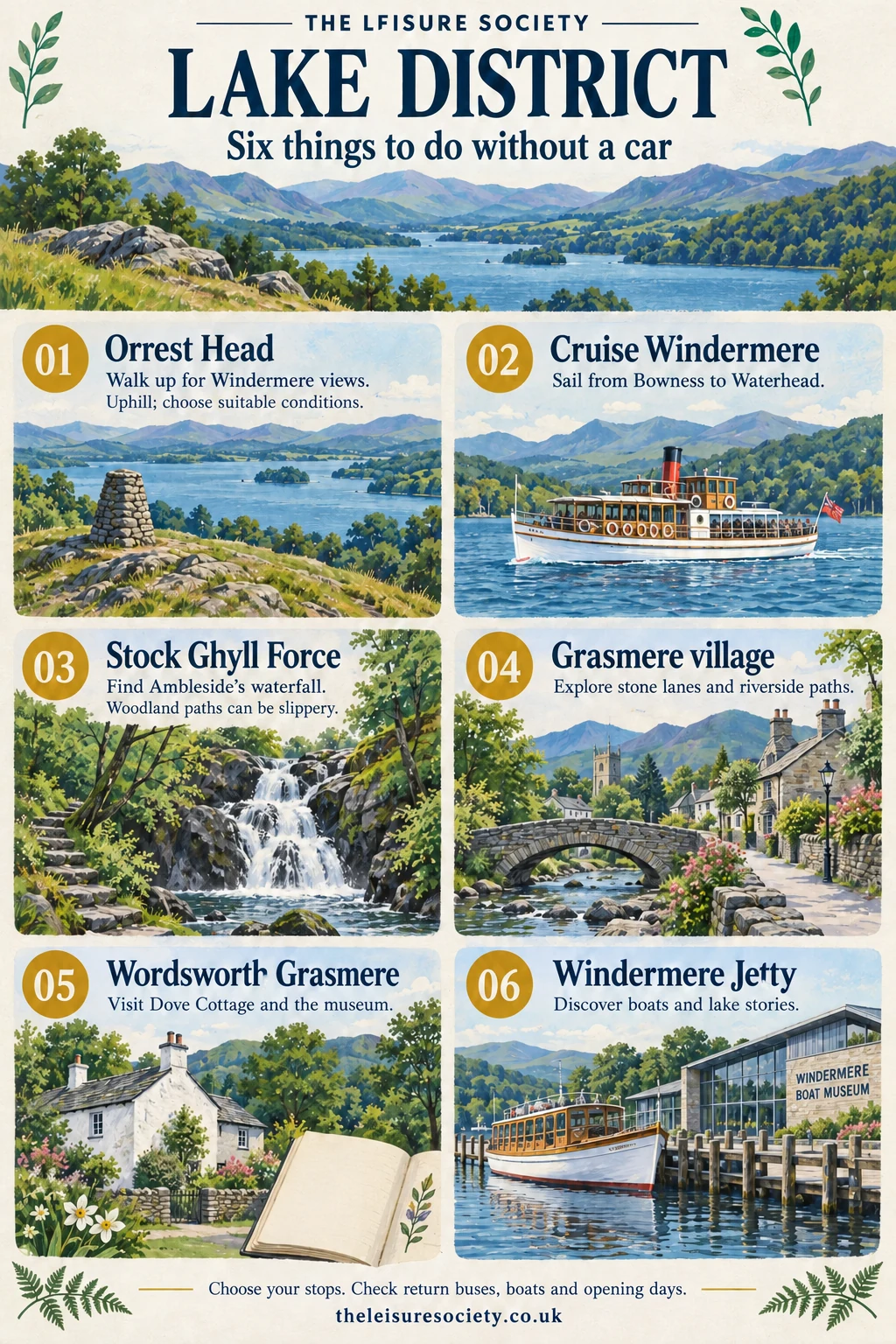
Read the infographic: six things to do
- Orrest Head: walk uphill for Windermere views in suitable conditions.
- Cruise Windermere: sail between Bowness and Waterhead.
- Stock Ghyll Force: visit Ambleside’s waterfall; woodland paths can be slippery.
- Grasmere village: explore stone lanes and riverside paths.
- Wordsworth Grasmere: visit Dove Cottage and the museum; check opening days.
- Windermere Jetty: discover boats and lake stories.
Where to stay, and how to arrive by train
Windermere town is the simplest base for this itinerary. Its station is inland, at the end of the branch line from Oxenholme Lake District on the West Coast Main Line. Northern puts the Oxenholme to Windermere journey at about 20 minutes. Book through to Windermere and check the connection, especially on Sundays or when engineering work is planned.
Bowness-on-Windermere is the waterfront alternative, roughly 1.5 miles downhill from the station. Choose it for an easy start to the boat day, but allow for a bus back uphill with luggage. Ambleside is another good base for walks and buses farther north; its centre is about a mile inland from Waterhead, where the cruise boats land. The national park’s guide to Windermere and Ambleside explains these distinctions.
Book accommodation within a manageable walk of the station or a useful bus stop, with places to eat nearby. Before paying, confirm breakfast times and luggage storage after checkout. An attractive room outside town can lose its price advantage once evening taxis enter the budget.
The bus and boat connections you will use
The 599 bus links Bowness, Windermere station, Waterhead, Ambleside and Grasmere. The 555 provides another option between Windermere, Ambleside and Grasmere, continuing towards Keswick or Kendal and Lancaster. Check the particular journey’s stops rather than assuming the two routes are interchangeable.
| Journey | Service and stop | Approximate travelling time |
|---|---|---|
| Windermere station to Bowness | 599 towards Bowness; alight at or opposite Bowness Pier, as shown for your journey | 8–10 minutes |
| Bowness to Waterhead | Red Cruise to Ambleside (Waterhead) Pier | 35 minutes each way |
| Waterhead to Ambleside centre | 599 towards Grasmere, to Kelsick Road | About 4 minutes on the bus |
| Windermere station to Grasmere | 599 to Grasmere Centre; 555 is an alternative, with its own timings | About 35 minutes on the 599 |
These are time on the vehicle, excluding waiting, boarding and traffic delays. The 599 summer 2026 timetable supports the bus estimates above. For orientation, save the Stagecoach route map; use the operator’s current journey planner for your travel date.
The route in brief: Oxenholme → train → Windermere station. From there, the 599 connects south to Bowness and north to Waterhead, Ambleside and Grasmere. The Red Cruise links Bowness and Waterhead across the lake.
Stagecoach currently caps participating single fares at £3. Its adult North West Explorer costs £12.50 for one day or £28 for three days. Two capped singles cost at most £6, so an unlimited ticket is not automatically the cheapest choice. Buy singles on board by card or cash, or compare tickets in the app.
Day one: arrive and walk to Orrest Head
Leave your bags at your accommodation, eat lunch in Windermere and keep the afternoon for Orrest Head. The reward is a view over the lake and surrounding fells without another transport connection. Allow 1–1.5 hours for the return walk and time at the viewpoint, longer if your group needs a gentler pace.
The national park’s Orrest Head route starts on the lane beside the lower entrance to the Windermere Hotel, about three minutes from the station. Its described round trip is 3.5km with around 120m of ascent. Follow the blue waymarks for the accessible route; red alternatives include steps.
“Miles without Stiles” does not mean level ground. Orrest Head is graded “for some”, with sections as steep as 1:4. Read the route’s equipment and access advice before attempting it with a wheelchair, mobility scooter or pushchair. In poor visibility, strong wind or fading daylight, keep the afternoon in town and move the viewpoint to another day.
Finish with dinner near your accommodation. Keeping the first evening local leaves room for a delayed train and avoids starting the break with a race for the last bus.
Day two: sail to Ambleside and visit Stock Ghyll Force
After breakfast, take the 599 down to Bowness Pier if you are staying in Windermere. Choose a morning sailing on Windermere Lake Cruises’ Red Cruise to Waterhead. The adult return is £19.20 for the published 28 March–1 November 2026 season. A one-way crossing takes about 35 minutes; the 75-minute figure advertised for the cruise is the non-landing return circuit.
A return ticket lets you break the journey and come back on a later sailing. Before boarding, choose a return that leaves roughly four hours ashore and check which pier it uses. Keep an earlier sailing in reserve. If you would rather return by bus, compare a single boat ticket or the operator’s combined tickets instead of buying an unused boat return.
At Waterhead, either walk towards Ambleside centre or use the short bus connection to Kelsick Road. Allow about 25–30 minutes for the roughly mile-long walk, with extra time for stops. Have lunch in the centre before following signs from Stock Ghyll Lane towards the waterfall.
Stock Ghyll has a signed woodland circuit from its southern entrance, passing viewing platforms and crossing above the falls before returning downhill. Set aside about an hour from the town centre for a relaxed visit. The paths can be uneven and slippery, so this is a footwear-with-grip walk rather than a smooth promenade. The council lists a separate accessible entrance to the upper viewing platform; that does not make the whole woodland circuit step-free.
For a wetter afternoon, substitute the Armitt museum on Rydal Road, which explores Ambleside’s history and holds work by Beatrix Potter and Kurt Schwitters. Allow about an hour. Adult admission is £7.50, with level access and a platform stairlift between floors. Through 31 October 2026 it opens Tuesday–Saturday, 10am–5pm; from 4 November–19 December it opens Wednesday–Saturday, 10.30am–4.30pm. Last entry is half an hour before closing.
Return to Waterhead with time to spare before your sailing, then take the 599 back up to Windermere if needed. If the Armitt is closed and conditions rule out the woodland, make this a shorter town-and-boat day rather than adding a walk simply to fill the afternoon.
Day three: Grasmere, with a shorter option before your train
Ask your accommodation to hold your bags and take a morning 599 or 555 north. On the 599, Windermere station to Grasmere Centre is about 35 minutes in the published timetable. Give the village around three hours, plus travel and a generous margin for collecting luggage before your train.

For an outdoor morning, follow the Grasmere Jubilee Walk from Broadgate Meadows. The national park describes a 1.8km circuit taking about an hour, linking the River Rothay, woodland and fields below Allan Bank. There is time afterwards for lunch and a look around the village before heading back.
The full circuit is graded “for some”: the woodland section includes a 50m slope of up to 1:5, and there are short road sections. Follow the official anti-clockwise route and its access notes. Travellers who need easier terrain should use the described “for all” sections rather than assuming the complete loop is suitable.
For a cultural visit, choose Wordsworth Grasmere, including Dove Cottage and the museum, instead of trying to fit everything into the morning. Allow roughly two hours and use the Dove Cottage bus stop, close to the entrance. The standard adult ticket is £16; the venue advertises 20% off on arrival with a bus ticket, bringing that to £12.80. Check how to claim the offer before prebooking.
At the time of checking, Wordsworth Grasmere opens Tuesday–Saturday, 10am–4pm, with the last cottage entry at 3.20pm. It is therefore not a Sunday or Monday fallback. Check its separate access guide for the cottage, museum and grounds. If this is a Friday-to-Sunday break, use the walk on Sunday, or swap the Grasmere and Ambleside days to visit Wordsworth on Saturday.
For an earlier train or a wet Sunday, stay around Bowness and visit Windermere Jetty Museum. Its boats, galleries and conservation displays give you an indoor focus closer to your base. Adult museum admission is £12; boat experiences cost extra. During 5 October–1 November 2026 it opens Tuesday–Sunday, 10am–5pm, changing to 10am–4pm from 2 November. Monday openings are limited to listed exceptions. Allow 1–2 hours for the museum and around 15–20 minutes to walk there from Bowness Pier via Rayrigg Road.
For the journey home, aim to reach Windermere at least an hour before your train, with additional time if you need to collect bags elsewhere. That is a planning cushion, not a guaranteed connection: leave earlier when traffic or service disruption is reported.
What to budget for local travel and attractions
For one adult staying in Windermere, the basic plan below uses six separate bus journeys: two between Windermere and Bowness, two between Waterhead and Ambleside, and two between Windermere and Grasmere. It assumes the current £3 cap applies to each journey and that you choose the walks rather than paid museums.
| Item | Allowance |
|---|---|
| Six capped bus singles | Up to £18 |
| Red Cruise adult return | £19.20 |
| Walks at Orrest Head, Stock Ghyll and Grasmere | No admission allowance |
| Local transport total | Up to £37.20 |
| Optional Armitt visit | Add £7.50 |
| Optional Wordsworth visit with advertised bus discount | Add £12.80 |
| Transport plus both museum options | Up to £57.50 |
This is a local spending guide, not a complete holiday price: add rail travel from home, two nights’ accommodation, food and any extra journeys. The Jetty Museum alternative changes the itinerary and costs £12 separately. On the four-bus day, capped singles total at most £12, just below a £12.50 day ticket; compare again if you add journeys. Keep a contingency for disrupted transport.
Before you set off
Book the train and accommodation first, then any timed attraction you particularly want. Save current outward and return timetables offline, including an earlier return, and check service notices each morning. Boat sailings and open-top bus experiences depend on weather and operating conditions; reduced winter schedules can change the shape of the day.
Take waterproofs, a warm layer and shoes with grip, and keep outdoor plans within the daylight available. This itinerary’s advantage is its modest geography: when conditions change, you can shorten a walk, choose a museum or return to your base without having committed to a remote valley.
Further Reading