Last Updated on 12th October 2026
From the resort-friendly sands of Santa Maria to the sweeping dunes of Praia de Chaves, Cape Verde’s best beaches offer very different experiences. The key is choosing the right island before booking your hotel.
Travel information checked in August 2026. Entry requirements, transport services and local beach conditions can change, so check official guidance before travelling.
Cape Verde, officially known as Cabo Verde, is an Atlantic archipelago off the coast of West Africa. Its dry climate, broad sandy beaches and strong water-sports culture have made it an increasingly familiar choice for British holidaymakers.
Figures from Cabo Verde’s National Statistics Institute show that the UK was the country’s largest overseas tourism market in 2025. Sal and Boa Vista received the overwhelming majority of hotel guests, reflecting their established resort infrastructure and extensive beaches.
But the islands are not interchangeable. Santa Maria and Kite Beach are on Sal, Praia de Chaves is on Boa Vista, and Tarrafal is at the northern end of Santiago. They cannot all be treated as easy day trips from one hotel.
At a glance
| Beach | Island | Best for | What to know |
|---|---|---|---|
| Santa Maria Beach | Sal | First visits, resort facilities, boat trips and swimming | The liveliest and most developed choice |
| Praia de Chaves | Boa Vista | Long walks, dunes, couples and quieter beach time | Facilities vary considerably along the beach |
| Kite Beach | Sal | Kitesurfing, windsurfing and watching experienced riders | Wind and waves make it less suited to casual swimming |
| Tarrafal Beach | Santiago | A sheltered bay, local food and a less resort-led visit | Best combined with a wider trip around Santiago |

Choose the island before choosing the beach
Sal is generally the simplest option for a first beach holiday. Santa Maria has restaurants, bars, accommodation, water-sports schools and organised excursions within a relatively compact area.
Boa Vista offers a more spacious landscape, with long dune-backed beaches and substantial stretches of coast that feel quieter than central Santa Maria. Large resorts occupy parts of the island, but visitors can still find broad areas of open sand.
Santiago is a different proposition. It is Cape Verde’s largest and most populous island, with the capital Praia, historic towns, mountain scenery and a stronger sense of everyday local life. Tarrafal works well for travellers who want beach time as part of a broader cultural trip rather than an entirely resort-based holiday.
Travellers wanting a rundown of what to expect from Cape Verde holidays centred around epic beach days should check the island as carefully as the hotel. Booking accommodation on Sal will not put Praia de Chaves or Tarrafal within easy reach.
Santa Maria Beach, Sal
Santa Maria is Cape Verde’s best-known beach destination and the most straightforward choice for first-time visitors.
The beach extends for several miles along Sal’s southern coast, with pale sand, blue Atlantic water and a broad selection of accommodation, restaurants, bars and activity providers nearby.
Its central sections are convenient for people who want to move easily between the beach, town and hotel. Visitors can arrange boat trips, snorkelling, diving, paddleboarding and other water-based activities without travelling far across the island.
The pier is one of Santa Maria’s focal points. Fishing boats bring their catch ashore, excursion boats collect passengers and visitors gather to watch activity on and around the water.
Santa Maria suits travellers who want:
- a wide choice of hotels and restaurants;
- water-sports lessons and equipment hire;
- boat trips and organised excursions;
- a beach within walking distance of shops and evening entertainment; and
- a familiar resort base for a first Cape Verde holiday.
Some parts of the bay can be suitable for swimming when conditions are calm, but visitors should still choose a lifeguarded section and follow the beach flags. Cape Verde’s Atlantic conditions can change quickly, and a calm-looking surface does not always mean there is no undertow.
Santa Maria is less suitable for someone looking for complete seclusion. It is one of the country’s busiest visitor areas, particularly around the main hotels, beach clubs and pier.
Praia de Chaves, Boa Vista
Praia de Chaves offers a very different type of beach experience.
Located on Boa Vista, it is known for its extensive sands, rolling dunes and sense of open space. Even where hotels sit near part of the coast, the scale of the beach makes it possible to walk away from the busier areas.
The landscape is the principal attraction. Sand moves from the dunes towards the shoreline, creating broad views with relatively little development visible in some directions.
It is a good choice for couples, photographers, walkers and travellers whose ideal beach day involves space and quiet rather than a timetable of organised entertainment.
On calmer days, parts of the beach may be suitable for paddling or swimming. However, conditions vary along the coast and some stretches are exposed to Atlantic wind, waves and currents.
Visitors staying away from the beachfront hotels should arrange their outward and return transport before setting off. Facilities become limited on the quieter sections, so take water, sun protection and anything else needed for the visit.
Praia de Chaves is best for:
- long walks beside the Atlantic;
- dune scenery and open views;
- a slower and quieter beach day;
- couples and adults seeking space; and
- visitors prepared to plan transport and facilities in advance.
Kite Beach, Sal
Kite Beach, also associated with the Costa da Fragata coastline on Sal’s eastern side, is the strongest choice for visitors who want to get onto the water rather than spend the whole day on a sunlounger.
Consistent trade winds have helped Sal establish an international reputation for kitesurfing and windsurfing. Colourful kites are often visible across the sky, while local schools provide tuition and equipment for different experience levels.
The main wind-sports period generally runs from November into May, with some of the strongest and most reliable conditions typically occurring between January and April.
Complete beginners should book a recognised local school rather than hiring equipment independently. Wind direction, waves, currents, reefs and the number of other people on the water all need to be understood before launching.
Kite Beach is enjoyable from the shore too. Watching experienced riders can be a spectacle in its own right, particularly when the stronger winds bring skilled local and international kitesurfers onto the water.
It is not the best choice for a relaxed family swim. The characteristics that make it excellent for kitesurfing can make ordinary bathing less comfortable or less safe.
The surrounding Costa da Fragata area is also environmentally important. Its dunes, plants, wetlands and beaches support birds and nesting loggerhead turtles. Visitors should remain on established access routes, avoid driving over dunes and follow local conservation instructions.
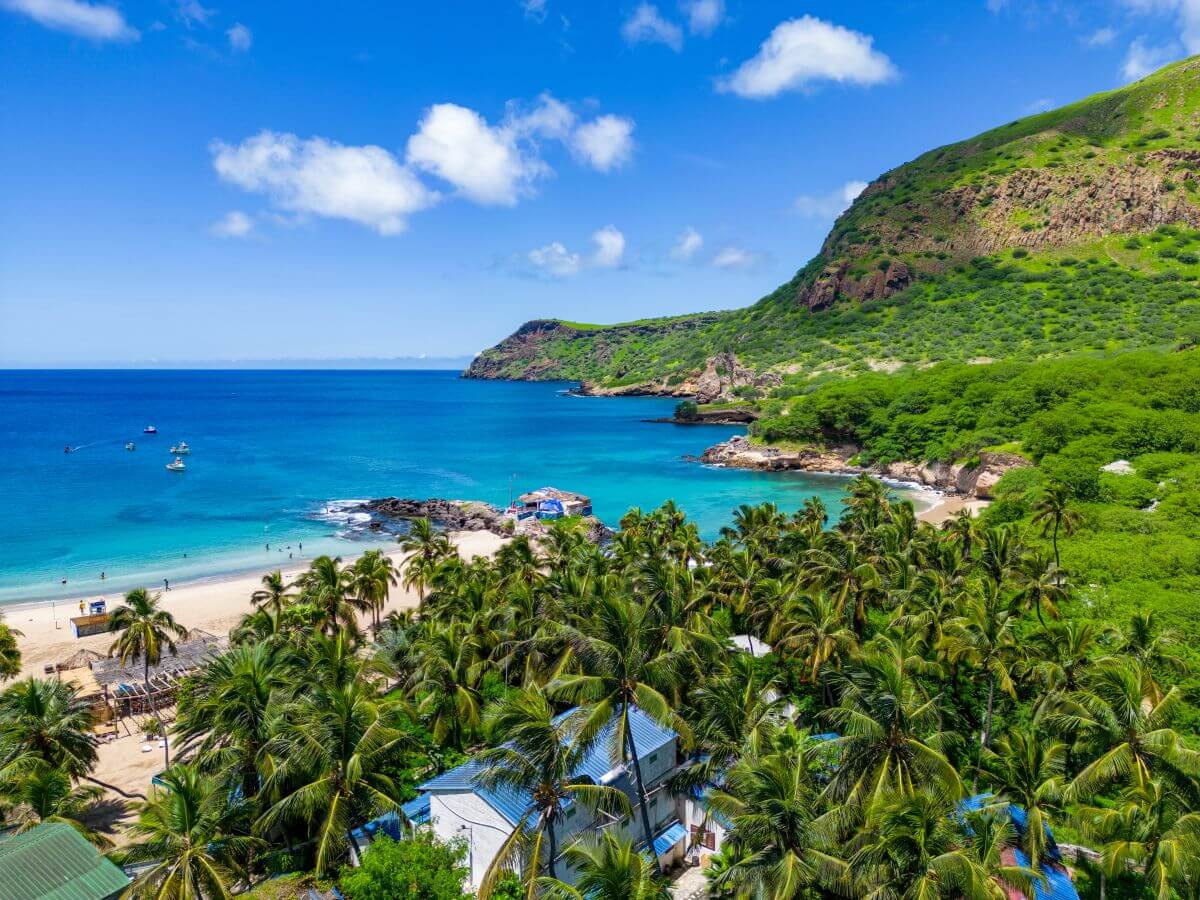
Tarrafal Beach, Santiago
Tarrafal Beach sits within a crescent-shaped bay on the northern coast of Santiago.
The bay is more sheltered than many of Cape Verde’s exposed Atlantic beaches, and its combination of golden sand, turquoise water and nearby coconut palms gives it a distinctly different character from the drier resort landscapes of Sal and Boa Vista.
Tarrafal is part of an active town rather than a self-contained resort. Fishing boats still use the shoreline, and nearby cafés and restaurants provide opportunities to try Cape Verdean seafood and local dishes.
That connection with the town is one of the beach’s main strengths. A visit can combine swimming and relaxing with time exploring the streets, eating locally and seeing a side of Santiago beyond the capital.
A comparatively protected setting can still have dangerous currents. Enter the water only where a lifeguard is on duty, follow the flags and instructions, and stay out if conditions are uncertain.
Tarrafal is especially suited to travellers who want:
- a beach with a strong connection to local life;
- restaurants and cafés within walking distance;
- a sheltered setting rather than an exposed ocean beach;
- time on the sand combined with a wider Santiago itinerary; and
- a less resort-focused holiday.
Do not confuse Tarrafal on Santiago with Tarrafal de Monte Trigo on Santo Antão. They are separate destinations on different islands.
Other Cape Verde beaches worth considering
These four beaches are useful starting points rather than a complete ranking of Cape Verde’s coastline.
Praia de Santa Mónica on Boa Vista is known for its immense stretch of sand and more remote atmosphere, although its exposure to the Atlantic means visitors need to take particular care around the water.
Laginha on São Vicente offers a more urban beach experience beside Mindelo, making it a good choice for travellers who want music, restaurants and city life alongside the coast.
Maio has fewer large resorts and a quieter tourism scene, with smaller beaches and guesthouses that may appeal to independent travellers seeking a slower stay.
When is the best time for a Cape Verde beach holiday?
Cape Verde has a dry, warm climate, but the best time depends on what visitors want to do.
| Travel priority | Period to consider |
|---|---|
| General beach holiday | The drier period broadly runs from November to July |
| Kitesurfing and windsurfing | Generally November to May, with strong conditions often found from January to April |
| Turtle nesting | Usually during the summer and early autumn, with exact regulated viewing dates varying |
| Quieter travel | Look beyond Christmas, Easter and the main European school-holiday periods |
Temperatures, wind and sea conditions differ between islands and from one side of an island to another. Visitors should check a local forecast rather than relying only on a general Cape Verde weather summary.
Watching nesting turtles responsibly
Loggerhead turtles nest on beaches across Cape Verde, including parts of Sal and Boa Vista.
The nesting period can create memorable wildlife-viewing opportunities, but the activity is regulated because approaching turtles, using inappropriate lights or walking through nesting areas can disturb adults and hatchlings.
Use a licensed or officially recognised guide and follow all instructions. Do not approach a nesting turtle independently or join an operator that drives over dunes or takes visitors onto restricted beaches without permission.
Project Biodiversity publishes current information about responsible turtle watching on Sal, while visitors to Boa Vista can consult local conservation organisations and approved operators.
Beach and swimming safety
Cape Verde’s beaches face the open Atlantic. Conditions can include powerful tides, unpredictable waves and strong undertows, even where the beach initially looks calm.
The Foreign, Commonwealth and Development Office advises visitors to use beaches with a lifeguard on duty.
Understand the beach flags
| Red flag | Do not enter the water |
| Yellow flag | Conditions require caution; swimming is not permitted |
| Green flag | Swimming is permitted, subject to the lifeguard’s directions; a green flag is not a guarantee of safety |
Always follow the lifeguard’s instructions. Keep children close, avoid swimming alone and do not assume yesterday’s conditions will be repeated today.
Take particular care when walking beside the water on isolated beaches. A larger wave can reach considerably farther up the sand than expected.
Before travelling from the UK
British passport holders can currently visit Cape Verde for up to 30 days without a visa.
Passports must have an expiry date at least six months after the date of arrival. Travellers must also complete the official entry pre-registration and pay the airport security tax at least five days before arriving, unless their tour operator has confirmed that it will complete this process for them.
From 1 July 2026, travellers who arrive without completing the pre-registration or without proof may be required to pay double the airport security charge at border control.
A UK Global Health Insurance Card is not accepted in Cape Verde. Medical facilities can be basic, particularly away from Praia and Mindelo, so insurance should cover treatment, planned activities and medical evacuation where necessary.
Check the latest FCDO Cape Verde travel advice before departure.
Verdict: which Cape Verde beach is best?
Choose Santa Maria for the most convenient first visit, with accommodation, food, excursions and water activities close together.
Choose Praia de Chaves for a quieter day of dunes, walking and open coastal scenery.
Choose Kite Beach for kitesurfing, windsurfing and the energy of Cape Verde’s water-sports culture.
Choose Tarrafal for a sheltered bay, local restaurants and a holiday that combines the beach with the culture and landscapes of Santiago.
The best choice depends less on which stretch of sand looks most impressive in photographs and more on the kind of holiday being planned. Pick the island first, understand the journey from the hotel and treat the Atlantic with respect once you arrive.
Frequently asked questions
Which Cape Verde beach is best for a first visit?
Santa Maria on Sal is generally the easiest option. It combines a long beach with hotels, restaurants, shops, excursions and water-sports providers.
Which beach is best for a quiet holiday?
Praia de Chaves on Boa Vista offers long stretches of dune-backed sand and more space than central Santa Maria. Facilities become limited away from the hotels, so plan transport and supplies.
Where is the best place for kitesurfing?
Kite Beach on Sal is one of the country’s established kitesurfing locations. Beginners should book instruction through a recognised local school.
Which beach is best for local culture?
Tarrafal on Santiago combines a picturesque bay with fishing activity, local restaurants and access to the wider history and landscapes of the island.
Can I visit Santa Maria, Praia de Chaves and Tarrafal during one holiday?
It is possible, but they are on three different islands. Inter-island flights or ferries would be required, and schedules can change. Most one-week visitors will have a more relaxed holiday by choosing one island.
Are Cape Verde’s beaches safe for swimming?
Conditions vary. Some bays are more sheltered, but strong currents and undertows occur around the islands. Use a lifeguarded beach, obey the flags and stay out of the water when warned.
When is the best time to visit?
The dry period from roughly November to July is popular for general beach holidays. Wind-sports visitors often favour November to May, while regulated turtle-watching opportunities occur during the summer and early autumn.
Do British visitors need a visa?
British passport holders can currently visit for up to 30 days without a visa, but must complete the traveller entry form and airport security payment requirements. Check the latest FCDO advice before travelling.