



















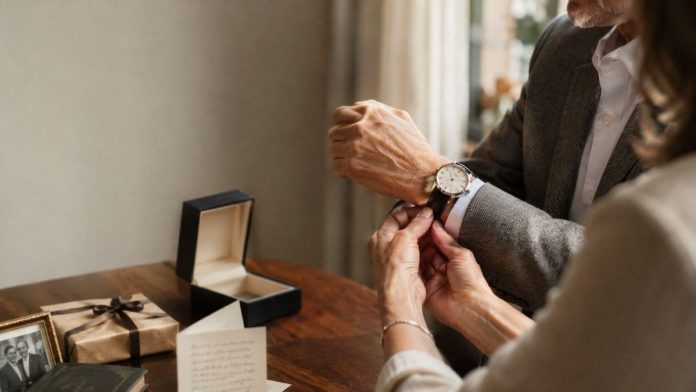
A milestone birthday, anniversary, retirement, promotion or Father’s Day can call for something more memorable than an ordinary present. A luxury watch can meet that need because it combines practical use, craftsmanship and personal meaning in one object.
Unlike a gift that is quickly consumed or replaced, a watch may become part of the recipient’s everyday life. It can accompany them to work, holidays, celebrations and quiet moments that were never planned in advance. With proper care, it may remain wearable for decades and eventually become associated with the person, occasion and family history behind it.
That does not make a luxury watch the right gift for everyone. The best watch is not necessarily the most expensive, technically impressive or recognisable. It is the one the recipient will genuinely enjoy wearing.
A useful rule is simple:
Buy the watch the recipient will wear, not the watch the giver most admires.
At a glance
A luxury watch is most likely to make a successful gift when:
- the recipient already enjoys wearing watches
- the design suits their lifestyle and personal style
- the size and weight are comfortable
- the movement fits their preferences
- maintenance and servicing expectations are understood
- the seller is reputable
- a pre-owned watch has been properly assessed
- the purchase is based on personal meaning rather than promised investment returns
Why a watch can carry personal meaning
A watch is closely connected with time, making it a natural way to recognise a new chapter or important achievement.
A retirement watch may represent the end of a long career and the beginning of greater freedom. An anniversary watch can mark time shared together. A watch given after a promotion, graduation or major personal achievement may become a reminder of the work that made the occasion possible.
Because watches are worn rather than simply displayed, the emotional association can strengthen over time. A small mark on the bracelet, a faded strap or a service receipt may eventually become part of the object’s story.
This sentimental value is different from financial value. A watch can be priceless to one person or family even if collectors would not regard it as especially rare or valuable.
Start with the recipient, not the occasion
The occasion explains why you are giving the gift. The recipient should determine what you buy.
Before looking at brands or models, consider:
- whether the person already wears a watch
- whether they prefer a traditional watch, smartwatch or fitness tracker
- whether their clothing is usually formal, casual, practical or sporty
- whether they work at a desk, travel frequently or spend time outdoors
- whether they prefer subtle design or recognisable branding
- whether easy legibility is important
- whether they enjoy mechanical objects
- whether they want something low-maintenance
- what size and weight they usually find comfortable
- whether they already own watches that reveal a clear preference
Look at the jewellery, accessories and watches they already choose. A small, understated watch may suit someone with a restrained style. A larger sports watch may work better for someone who prefers a more substantial design.
The recipient’s habits are more useful than current fashion. An award-winning watch that feels too heavy, too ornate or too fragile is unlikely to become an everyday favourite.
Understanding the main watch movements
Luxury watches are often associated with traditional mechanical watchmaking, but mechanical is not the only credible choice.
A mechanical watch stores energy in a mainspring. In an automatic watch, a rotor responds to movement and helps wind that spring. A hand-wound watch requires the wearer to wind it manually through the crown. Quartz watches use electronic regulation and are generally valued for their accuracy and convenience. Premium quartz movements can also involve considerable engineering and hand assembly; Grand Seiko’s 9F range is one example of high-end quartz construction.
| Movement | Why someone might choose it | What to consider |
| Automatic | Traditional engineering and no routine battery change | May stop when unworn and will eventually need servicing |
| Hand-wound | A more direct interaction and daily or regular winding ritual | Requires the wearer to remember to wind it |
| Quartz | Accuracy, convenience and lower everyday maintenance | Requires battery replacement unless it uses another power system |
| Hybrid or proprietary | Combines characteristics of mechanical and electronic regulation | Servicing may require a specialist or manufacturer network |
No movement is automatically right for every recipient.
A watch enthusiast may enjoy resetting an automatic watch after it has stopped. Someone who wants a watch that is always ready to wear may prefer quartz. A recipient who enjoys small daily rituals might appreciate a hand-wound movement.
Matching watch styles to different occasions
Watch categories are useful starting points, but they should not override the recipient’s taste.
| Occasion or recipient | Possible watch style | Main consideration |
| Retirement | Classic dress or versatile everyday watch | Comfort, legibility and long-term wear |
| Anniversary | Dress, jewellery or heritage-inspired watch | Personal symbolism and the recipient’s existing style |
| Career milestone | Refined everyday watch | Suitable for work and informal occasions |
| Milestone birthday | A model connected to the recipient’s interests or birth year | Wearability, condition and personal relevance |
| Frequent traveller | GMT or world-time watch | Ease of reading and changing time zones |
| Outdoor enthusiast | Diver, field or robust sports watch | Water resistance, legibility and durability |
| Watch enthusiast | Mechanical, vintage or unusual reference | Movement, originality, provenance and collector interest |
A diver’s watch can be robust and attractive, but it may be unnecessarily bulky for someone who wants a slim watch under a shirt cuff. A delicate dress watch may be elegant, but less suitable for a recipient who spends weekends hiking, sailing or working with their hands.
Make sure the watch fits
A watch is worn directly on the body, so fit is part of the gift rather than a minor technical detail.
Case diameter is only one measurement. Lug-to-lug length, case thickness, bracelet shape and overall weight all affect how a watch sits on the wrist.
Before buying, check:
- the recipient’s approximate wrist size
- whether the case extends beyond the wrist
- whether the watch will fit comfortably beneath clothing
- whether the bracelet can be resized
- whether all spare bracelet links are included
- whether shorter or longer straps are available
- whether the retailer offers resizing
- whether the watch can be exchanged if the fit is wrong
A gift receipt may feel less romantic than a complete surprise, but it can prevent an expensive watch from remaining unworn.
Consider the cost of ownership
The purchase price is not the only cost associated with a luxury watch.
Mechanical watches contain moving components that eventually require cleaning, inspection, lubrication and, where necessary, replacement parts. Quartz watches generally require less routine work, but batteries, seals and water-resistance checks still need attention. Manufacturers publish their own servicing recommendations, and intervals can vary by model, movement and use.
Before buying, find out:
- where the watch can be serviced
- what the manufacturer recommends
- what a routine service may cost
- whether specialist parts are readily available
- whether the warranty is international or limited to certain markets
- whether water resistance has been tested
- whether the watch should be insured
- whether the recipient will need a formal insurance valuation
These questions matter particularly with vintage, complicated and discontinued watches. A generous gift should not leave the recipient with an ownership cost they were not expecting.
Personalisation can add meaning
Engraving a case back can connect a watch directly to the occasion. Initials, a date or a short message may turn a luxury object into something unique to the recipient.
Before engraving, check:
- whether the case back is suitable
- whether engraving affects the warranty
- whether the recipient is likely to appreciate permanent personalisation
- whether the watch may need to be exchanged
- whether future resale flexibility matters
Engraving may reduce a watch’s appeal to future buyers, but that may be irrelevant when the intention is to keep it within the family.
The important point is to decide whether personal significance or future flexibility matters more.
Longevity does not make every watch an investment
Luxury watches are frequently described as investments, but the term should be used cautiously.
Some sought-after references have appreciated. Many others trade below their original retail prices. Performance can vary substantially according to brand, model, condition, originality, scarcity, purchase price and market demand. Secondary-market services therefore monitor individual watches and brand indexes rather than treating all luxury watches as a single investment category.
It is more useful to separate three types of value:
- Functional value: the watch can be worn and used for years.
- Sentimental value: it becomes connected to a person, relationship or occasion.
- Resale value: another buyer may be willing to purchase it in future.
The first two may be compelling reasons to buy. The third is uncertain.
A luxury watch should generally be bought because it suits the recipient and the occasion—not because future appreciation is assumed. Any increase in value should be treated as a possibility rather than a promise.
Why consider a pre-owned luxury watch?
For those seeking exceptional quality at a more accessible price point, second-hand watches offer an excellent opportunity to invest in renowned brands while maintaining both style and long-term value. Opting for a pre-owned luxury watch allows you to access iconic horological designs and superior Swiss craftsmanship without the steep initial depreciation of a brand-new model, making it both an aspirational and financially savvy gift.
A pre-owned watch can provide access to discontinued references, older proportions, vintage designs and models that are no longer available from an authorised retailer.
It may also offer better value when a particular model trades below its original retail price. However, a lower asking price does not automatically make a watch good value.
Condition, originality and documentation matter. A heavily polished case, replacement dial, missing bracelet links or poorly documented service history can affect both desirability and future value.
Before buying pre-owned, request:
- the exact model and reference number
- clear photographs from several angles
- a written condition report
- disclosure of replaced or non-original parts
- service and repair history
- confirmation of how authenticity was assessed
- details of the seller’s inspection process
- the original box and papers, where available
- all removable bracelet links
- warranty details
- return and exchange terms
- confirmation that the watch has been checked against relevant stolen-watch records
Boxes, papers, receipts and service records can strengthen provenance and reduce uncertainty, but documentation should be considered alongside the watch itself.
Some manufacturers operate certified pre-owned programmes. These may include brand authentication, servicing, testing and a new guarantee, although the exact standards and terms differ between programmes. Rolex, for example, states that watches within its certified pre-owned programme are authenticated, serviced, tested and supplied with a two-year international guarantee.
Buying safely from a UK trader
When a watch is purchased from a UK business, the Consumer Rights Act 2015 generally requires the goods to be of satisfactory quality, fit for any purpose agreed with the seller and as described. What counts as satisfactory can take account of factors such as the watch’s age, price, description and any faults clearly disclosed before purchase.
For a pre-owned watch, a visible scratch that was clearly photographed and described may form part of the agreed condition. An undisclosed functional fault is a different matter.
Before buying from a trader, check:
- the registered or trading name
- a physical business address
- reliable contact information
- independent reviews
- the written warranty
- the returns process
- the complaints procedure
- whether the seller belongs to a recognised professional body
- whether the watch description identifies known faults or replacement parts
The article is general information rather than legal advice. Seek advice relevant to the transaction if a dispute arises.
Buying from a private seller
A buyer has fewer protections when purchasing from a private individual than when purchasing from a business.
The seller must not misdescribe the watch. Where goods are sold by description, the item should correspond with that description under section 13 of the Sale of Goods Act 1979. However, the broader satisfactory-quality and fitness-for-purpose obligations applying to trader sales do not operate in the same way in a private transaction.
For a private purchase:
- inspect the watch in person where practicable
- ask direct questions about faults and replacement parts
- retain the advert and messages
- obtain a signed receipt
- record the seller’s name and address
- use a payment method that provides an appropriate record
- consider an independent inspection before completing an expensive purchase
Do not assume that a private seller’s positive reviews provide the same protection as buying from an established trader.
Buying a watch online
When a watch is bought online, by telephone or by mail from a business, the purchaser will generally have a 14-day cancellation period after receiving it, even where the item is not faulty. After notifying the seller, the consumer normally has a further 14 days to return the goods. The seller should explain the cancellation process before purchase.
There are exceptions. Goods made to the customer’s specifications or clearly personalised may be excluded from the usual cancellation right. A watch engraved to order may therefore be harder—or impossible—to return simply because the buyer changes their mind. Confirm the retailer’s policy before authorising engraving.
When buying online:
- review the cancellation and returns terms
- confirm whether bracelet resizing affects returns
- ask whether removing protective stickers affects eligibility
- check whether engraving makes the sale final
- save the product description and order confirmation
- inspect the watch promptly after delivery
- report damage or discrepancies without delay
Be alert to counterfeit watches
Counterfeit watches are a recognised risk in both physical and online resale markets. UK government guidance advises second-hand buyers to investigate unusually low prices, examine listings carefully and check authenticity before purchasing. Government material on intellectual-property crime specifically identifies watches among the product categories affected by counterfeiting.
Warning signs may include:
- a price far below comparable watches in similar condition
- copied photographs or inconsistent images
- reluctance to provide a reference or serial number
- vague claims about authenticity
- pressure to pay outside a recognised marketplace
- no verifiable business details
- no return process
- mismatched paperwork
- a seller who refuses an independent inspection
A reputable dealer should be prepared to explain what was inspected, who carried out the assessment and what remedy is available if a later authenticity concern arises.
When a luxury watch may not be the right gift
An expensive gift is not automatically a thoughtful one.
A luxury watch may be the wrong choice when:
- the recipient does not wear watches
- they strongly prefer a smartwatch or fitness tracker
- their style or wrist size is unknown
- they would feel uncomfortable receiving something so expensive
- the gift could create an unwanted sense of obligation
- they do not want future service or insurance costs
- the watch cannot be returned, exchanged or resized
- the purchase stretches the giver beyond an affordable budget
- the decision depends on assumed future appreciation
- the recipient would prefer an experience, contribution or practical gift
In some cases, involving the recipient is wiser than preserving the surprise. Choosing a watch together can still be meaningful, while avoiding an expensive mismatch.
Final checklist before buying
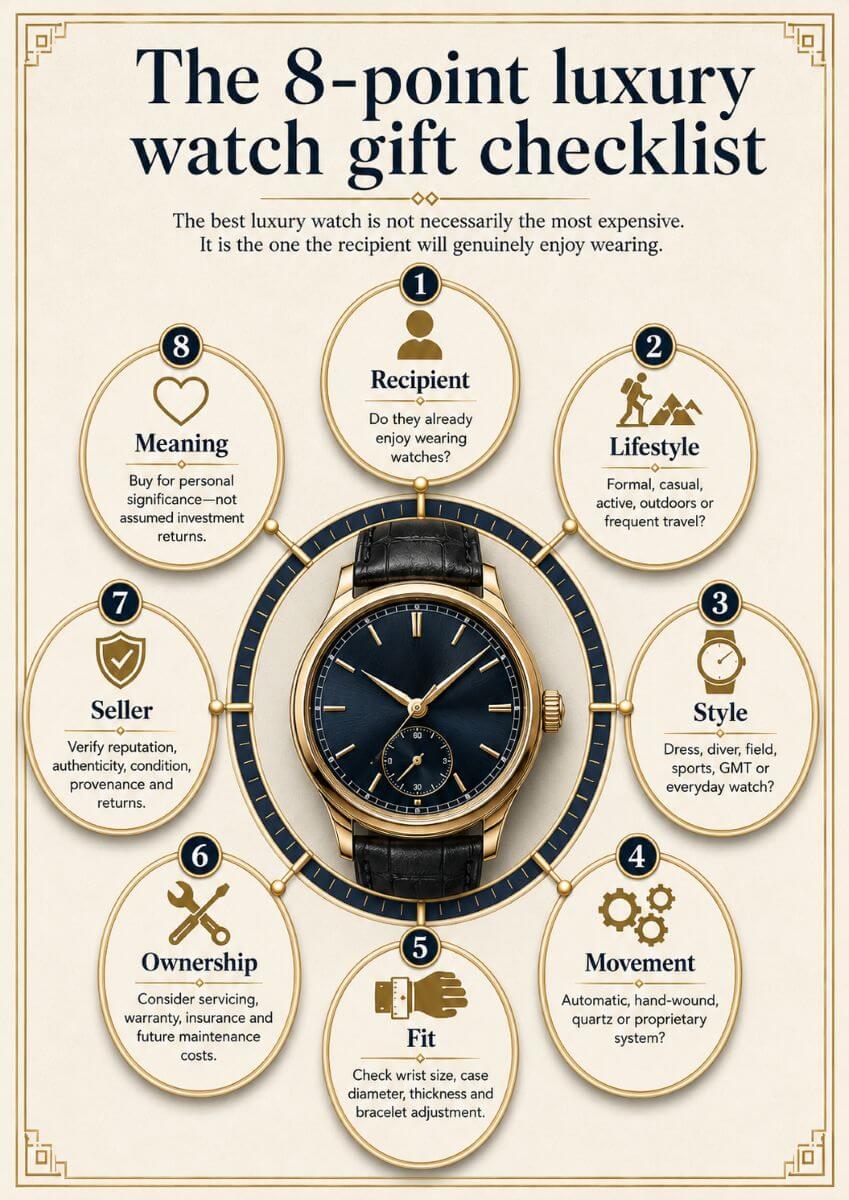
Before committing to a luxury-watch gift, ask:
- Does the recipient genuinely enjoy wearing watches?
- Does the design suit their style and daily life?
- Is the size comfortable for their wrist?
- Is the movement appropriate for their habits?
- Can the bracelet or strap be adjusted?
- Are servicing, warranty and ownership costs clear?
- Is the seller reputable, and has a pre-owned watch been properly assessed?
- Am I buying it for personal meaning rather than relying on future financial returns?
A gift designed to be lived with
A luxury watch can be a meaningful gift because its life does not end when the wrapping is removed. It may be worn to work the following morning, taken on future journeys and eventually associated with moments no one could have predicted on the day it was given.
Its significance comes from more than a logo, price or movement. The strongest gift reflects the recipient’s taste, habits and story.
Choose for the person. Understand the ownership responsibilities. Buy from a trustworthy source. When those elements align, a luxury watch can become both a useful object and a lasting connection to the occasion it was chosen to mark.